


There’s a sentence I’ve been hearing a lot lately.
“Retention just happens naturally.”
And I get it. I genuinely do. When customer satisfaction is high, delivery is strong, and clients have been with you for years, retention can feel like something that simply “takes care of itself.”
I used to believe that too.
But over time I learned that hope can be dangerous in retention. It sounds positive, but it can create blind spots. You assume things are fine, you expect customers to stay, and that’s exactly when you miss the signals that something is slowly shifting.
Which brings me to a line I keep repeating because it’s painfully simple:
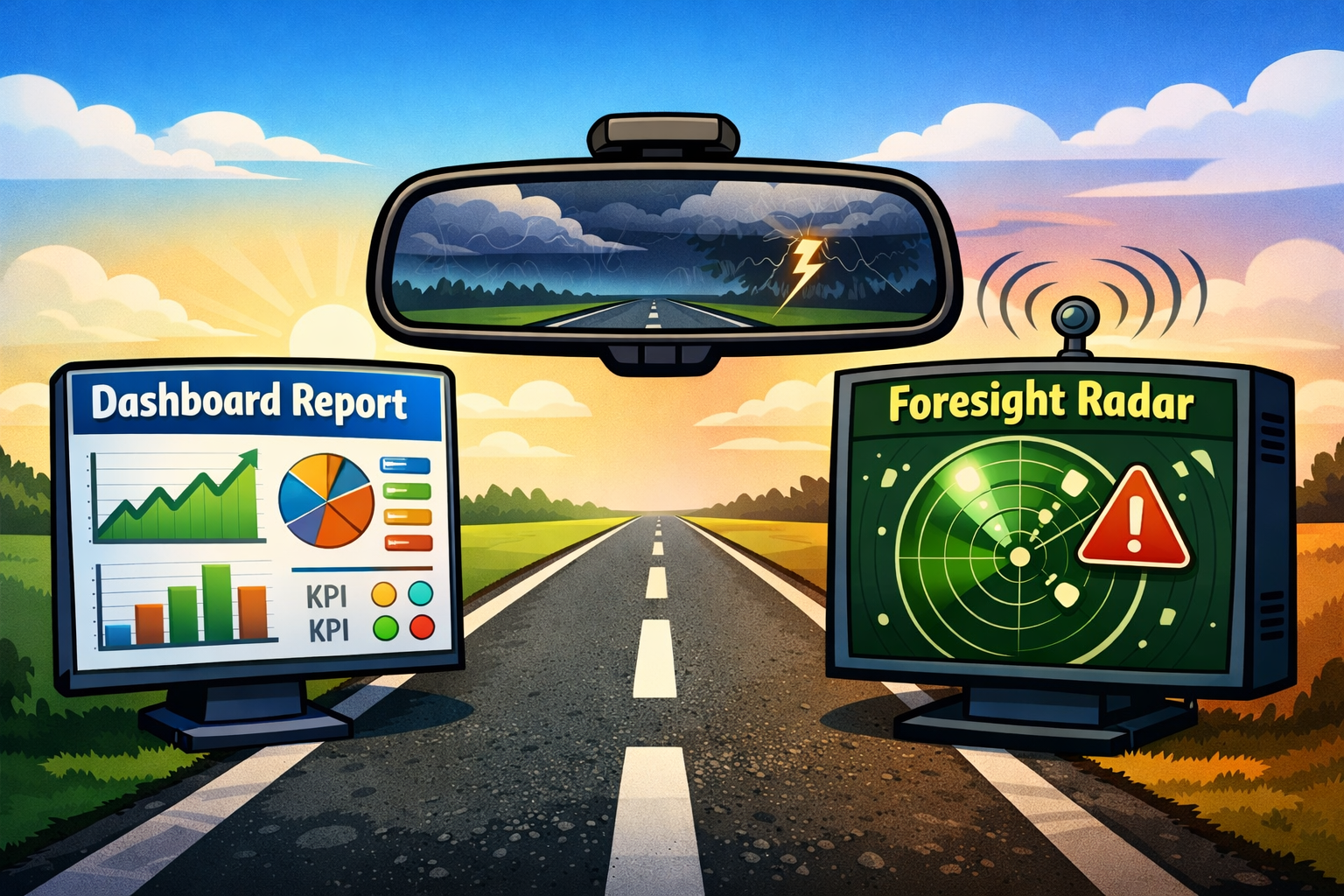
You can’t prevent churn with a rearview mirror.
Right?
1) The real problem: churn rarely starts in the numbers
What I see in many organizations (from scale-ups to enterprises) is that churn feels like a sudden event.
A customer cancels.
A contract doesn’t get renewed.
The renewal becomes smaller.
Or the project stops “unexpectedly.”
And then the familiar sentence appears:
“We didn’t see this coming.”
But most of the time, that’s not true.
Churn rarely starts in the numbers.
Churn starts in the relationship.
And relationships tend to follow a predictable pattern:
- first, emotional detachment (less energy, less trust, less excitement)
- then, operational detachment (less collaboration, fewer interactions, less initiative)
- and only later, financial detachment (reduced spend, reduced scope, reduced commitment)
So when churn finally shows up in revenue, you’re often looking at the final chapter of a story that started months earlier.
2) The real villain: the Dashboard Illusion
I call this the Dashboard Illusion.
The illusion that “if it’s not in the dashboard, it doesn’t exist.”
Dashboards are built for reporting. For history. For looking backward. They tell you what happened, not what’s coming.
And yet, many organizations treat the dashboard as truth.
KPIs are green → so everything must be fine.
NPS is okay → so the relationship is healthy.
Tickets are resolved → so the customer is happy.
But churn doesn’t come from the dashboard.
Churn comes from the human system around the customer.
3) Retention isn’t luck. It’s a system (Joey Coleman was right)
The interesting part is: this isn’t new.
Joey Coleman has been saying this for years. In his great book Never Lose a Customer Again (and honestly: he’s been teaching this for 15+ years), he makes one thing clear:
Retention isn’t luck.
Retention is a system.
A series of moments, expectations, emotions, and experiences that determine whether a customer:
- builds trust
- feels loyalty
- refers others
- or slowly drifts away
That’s why the word “natural” is dangerous in retention.
“Natural” sounds like it happens automatically.
But retention doesn’t happen automatically.
Retention happens intentionally.
4) The shift: from dashboards to Foresight
So if dashboards mainly look backward… what do you actually need?
You need something that looks forward.
That’s what we call Foresight.
And the definition I keep using is this:
Foresight is turning early Human Signals into actionable early warnings before outcomes show up in the dashboard, so you can prevent churn instead of explaining it.
It sounds simple, but the impact is huge.
Because if you can detect churn risk 3–6 months earlier, you gain something most organizations rarely have:
time.
Time to repair trust, reset expectations, realign stakeholders, and strengthen the relationship while it’s still fixable.
5) Which Human Signals predict churn?This is where it gets interesting.
Most churn signals aren’t “hard data” like revenue or usage.
They’re human.
A few examples of Human Signals that often appear before churn:
Signals of trust decay
- customers ask more controlling questions
- more escalations or political tension
- less openness in conversations
Signals of disengagement
- meetings get shorter or are rescheduled more often
- less initiative from the customer side
- key stakeholders disappear or delegate everything
Signals of misalignment
- customer goals change without involving you
- the customer talks more about price than impact
- value perception shifts (subtly)
Signals of silent dissatisfaction
- the customer says “everything is fine” but the energy is gone
- less feedback (which is often not a good sign)
- less excitement about next steps
Most organizations can feel these signals, but they don’t track them. Or they ignore them because KPIs still look good.
That’s the Dashboard Illusion again.
6) What we do at HumintyX (light)
At HumintyX, within HumintyX Science, we work with the concept of Human Signals Intelligence: detecting the early human patterns that predict retention risk.
To make this practical, we introduced the language of the HumintyX Foresight Early Warning System: a way to detect early signals so you have months of runway to keep customer relationships healthy.
Not to “score” customers.
But to understand them better.
And to make churn prevention proactive instead of reactive.
7) One simple reflection question (that is often confronting)If you recognize this, ask yourself one question:
When churn happens, is it usually:
A) “We saw it coming, but we didn’t act fast enough.”
B) “Churn surprised us, even though the dashboard looked fine.”
If your answer is often B, you may not have a churn problem.
You may have a Foresight problem.
Closing thought
Dashboards aren’t bad.
But dashboards are backward-looking.
And you can’t prevent churn by looking backward.
You can’t prevent churn with a rearview mirror. Right?
Curious: what Human Signals do you usually notice first when a customer relationship starts drifting?
Warm regards,
Jeroen
