


I’m a KPI Black Belt, so I’ll keep this grounded and operational.
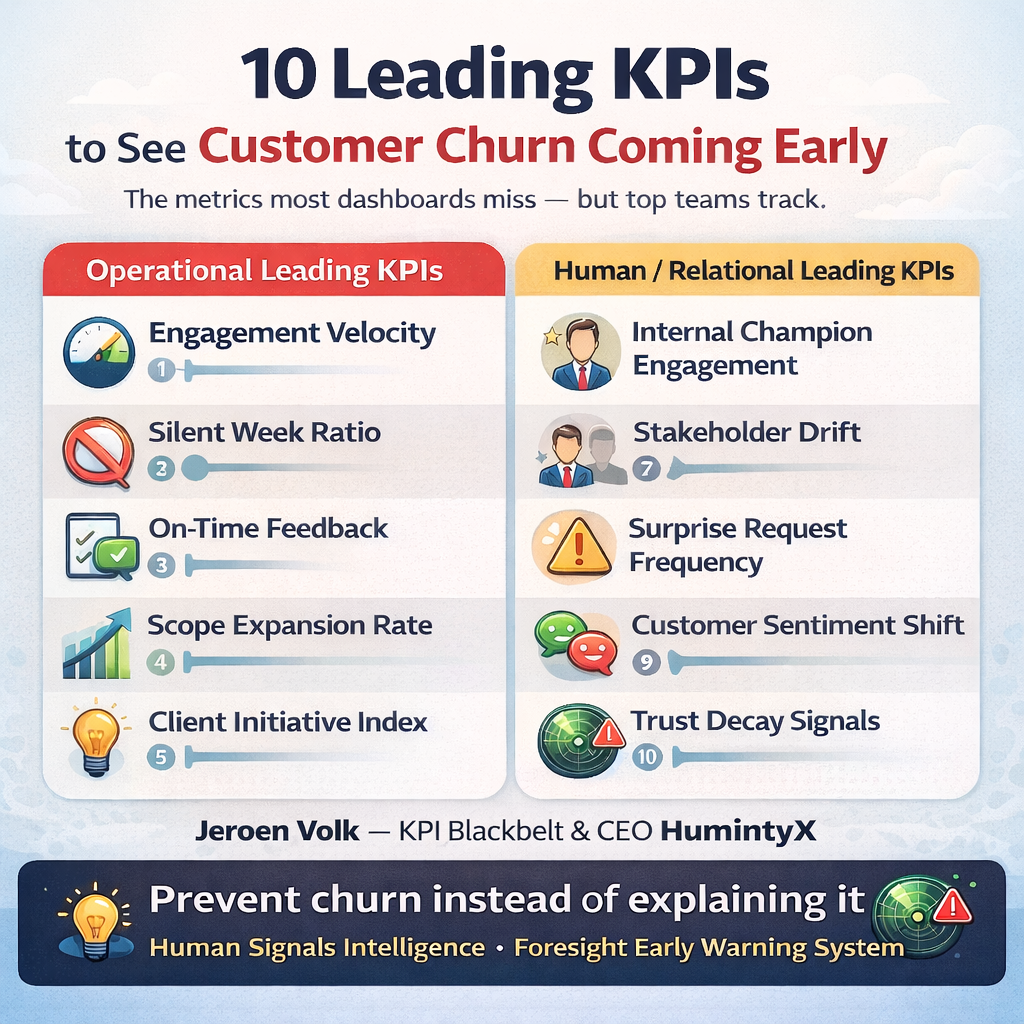
These are the KPIs I’d want in any marketing company that wants to prevent churn instead of explaining it.
And yes… some of these will trigger the reaction:
“YESSS we should track that.”
And some will trigger:
“Wait… but HOW do you measure that?”
That second reaction is not a bug.
That’s the whole point.
1) Customer Engagement Velocity
Definition: The frequency and speed of meaningful customer interactions over time.
How to measure: # meetings, # strategic touchpoints, response time, inbound messages per week.
Why it predicts churn: Engagement drops long before customers cancel.
Early warning sign: Meetings become shorter, fewer, delayed, or “someone else joins instead.”
2) Silent Week Ratio
Definition: The % of weeks with no meaningful inbound communication from the customer.
How to measure: Weeks with no replies, no new requests, no proactive contact.
Why it predicts churn: Silence is one of the strongest early signals of disengagement.
The tricky part: Silence looks like “peace”… until it’s churn.
3) On-Time Feedback Ratio
Definition: % of deliverables that receive customer feedback on time.
How to measure: Feedback within X days of delivery.
Why it predicts churn: Late feedback often means the work is no longer a priority, or internal alignment is shifting.
4) Scope Expansion Rate
Definition: Rate of growth inside existing customers (new services, added campaigns, extra budget).
How to measure: Expansion revenue, added scope count, upsell acceptance rate.
Why it predicts churn: Expansion slows before retention breaks.
5) Client Initiative Index
Definition: How often the customer initiates actions (new ideas, requests, strategy topics).
How to measure: # customer-initiated messages, # proactive asks, # new topics per month.
Why it predicts churn: When initiative drops, ownership drops. When ownership drops, loyalty drops.
6) Internal Champion Engagement Index
Definition: Engagement level of your key sponsor / internal champion at the customer.
How to measure: Sponsor attendance, responsiveness, proactive involvement, strategic input.
Why it predicts churn: If you lose the champion, churn risk spikes.
The “how to measure” problem: Champions don’t announce they’re leaving emotionally. They just fade.
7) Stakeholder Drift Score
Definition: The degree to which stakeholders change or shift without you being included.
How to measure: # stakeholder changes, reduced access to decision makers, new “gatekeepers”.
Why it predicts churn: Drift often means internal politics changed and you’re no longer essential.
8) Surprise Request Frequency
Definition: The number of last-minute “urgent” requests or sudden changes.
How to measure: Count “urgent” tasks, scope-change frequency, ad-hoc requests.
Why it predicts churn: Chaos and urgency often correlate with internal pressure, disappointment, or misalignment.
The twist: It’s not the urgent request that kills retention. It’s what caused it.
9) Customer Sentiment Shift
Definition: Change in emotional tone in emails, meetings, chats, and conversations.
How to measure: Sentiment analysis + human interpretation (tone, language patterns, energy).
Why it predicts churn: Customers leave emotionally before they leave financially.
And yes: this is where most teams say “How do we track this reliably?”
10) Trust Decay Signals (Composite KPI)
Definition: Early behavioral indicators that trust is declining.
Signals include: more controlling questions, defensive tone, more escalations, avoidance behavior, less openness.
How to measure: A pattern-based model, not a single metric.
Why it predicts churn: Trust decay is churn in slow motion.
This is the KPI most dashboards will never show you.
Notice something?
Half of these KPIs are measurable with systems you already have.
But the other half are different.
They’re not “numbers.”
They’re signals.
Human signals.
And if you’re thinking:
“These are powerful… but measuring them feels hard.”
You’re right.
That’s why churn remains a surprise for so many teams.
The shift: from reporting to Foresight
This is where we use the word Foresight at HumintyX.
Not as a buzzword.
As a discipline.
Here’s the definition we work with:
Foresight is turning early Human Signals into actionable early warnings before outcomes show up in the dashboard, so you can prevent churn instead of explaining it.
That’s also why, inside HumintyX Science, we introduced Human Signals Intelligence.
Because if you can detect churn risk 3–6 months earlier, you gain something that changes everything:
time.
Time to repair trust.
Time to reset expectations.
Time to realign stakeholders.
Time to strengthen the relationship while it’s still fixable.
A final question
Let me ask you a simple question.
When churn happens in your business, is it usually:
A) “We saw it coming, but we didn’t act fast enough.”
B) “Churn surprised us, even though the dashboard looked fine.”
Drop A or B in the comments.
And if you want, I’ll share the exact framework we use to turn these KPIs into a real Foresight Early Warning System, a Foresight Radar.
Warm regards,
Jeroen
