


Every executive has heard it.
“We love working with you. But due to budget constraints, we’ve decided not to renew.”
It sounds reasonable.
It sounds external.
It sounds uncontrollable.
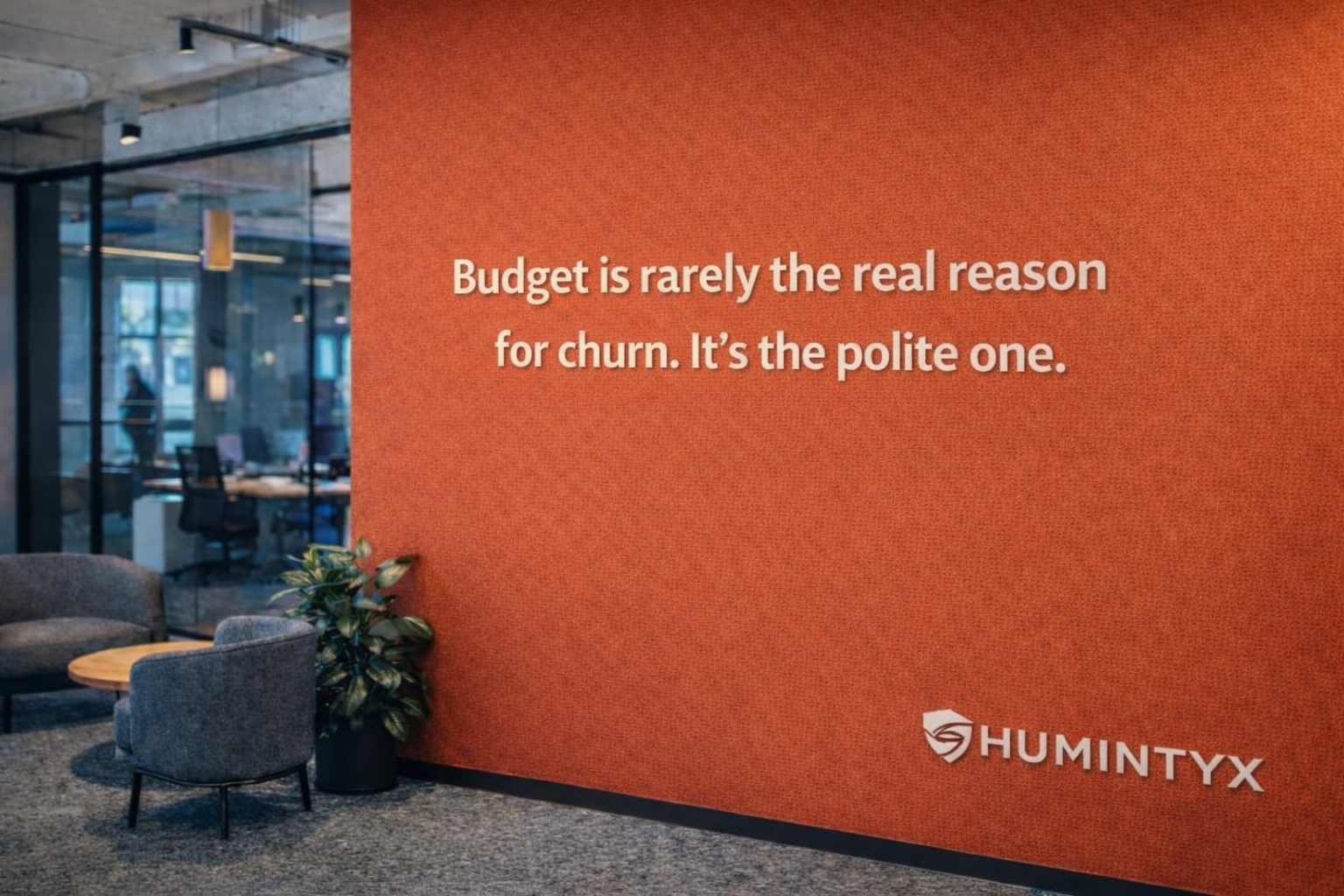
But in most B2B environments, budget is not the real reason.
It’s the polite one.
The Comfortable Story
When customers churn, organizations search for a clean explanation.
Price.
Competition.
Procurement.
Budget cuts.
These are neat narratives. They are easy to report internally. They protect ego. They reduce conflict.
But churn rarely begins in procurement.
It begins much earlier.
As described in The Churn Surprise, churn almost never starts with cancellation — only the cancellation feels sudden Book 02 from Traditional Custom….
The decision usually forms months before the “budget conversation” ever happens.
Customers Leave Emotionally First
Customers do not wake up one morning and suddenly discover they can’t afford you.
They drift.
They:
- stop sharing internal plans
- reduce engagement
- become more transactional
- cancel meetings without rescheduling
- stop advocating internally
As explored in Customers Leave Emotionally First, churn begins in belief decay — not financial spreadsheets Book 02 from Traditional Custom….
When belief weakens, budget becomes the justification.
Not the cause.
The 180-Day Problem
Most churn decisions are emotionally formed long before renewal.
In many B2B environments, the real decision to leave is made 120–180 days before cancellation Book 02 from Traditional Custom….
By the time procurement enters the conversation, the relationship has already crossed an invisible inflection point.
Budget is simply the final narrative.
And it is a socially acceptable one.
No one wants to say:
- “We lost confidence.”
- “We no longer see you as strategic.”
- “You became a vendor instead of a partner.”
So they say:
“Budget.”
The Dashboard Illusion
Here is where it becomes dangerous.
Most organizations trust dashboards to warn them.
Health scores are green.
Usage is stable.
NPS is acceptable.
Renewal probability looks fine.
Everything appears under control.
But as described in The Dashboard Illusion, dashboards confirm what has already happened. They rarely detect the early emotional shifts that precede churn Book 02 from Traditional Custom….
Dashboards measure visible activity.
Churn begins in invisible intent.
When leaders say, “The dashboard looked fine,” what they often mean is:
“The system wasn’t designed to see belief drift.”
Budget Is the Last Symptom
By the time “budget” appears:
- Attention has already declined.
- Trust has already weakened.
- Momentum has already slowed.
- Internal narrative has already shifted.
Budget is the organizational language used to formalize a decision that emotionally formed months earlier.
And this is why so many churn analyses feel unsatisfying.
Because they analyze the last conversation, not the first drift.
The Real Question
Instead of asking:
“Why did they churn?”
A more powerful question is:
“What was happening in the relationship 180 days earlier that we ignored?” Book 02 from Traditional Custom…
That question changes everything.
It moves retention from reactive explanation to predictive discipline.
From Traditional Customer Success to Foresight
Traditional Customer Success is not wrong.
It is incomplete.
It was designed to manage what is visible — usage, tickets, health scores, renewal probability.
But churn prevention requires something different:
- Interpreting weak signals
- Detecting behavioral drift
- Tracking sentiment shifts
- Forecasting relationship direction
That is where Human Signals Intelligence emerges as a discipline — not as a replacement for Customer Success, but as its evolution Book 02 from Traditional Custom….
Because the future of retention does not live in better dashboards.
It lives in earlier interpretation.
A Hard Truth for Leaders
If budget is your most common churn reason, you may not have a pricing problem.
You may have a belief problem.
And belief problems never show up first in financial reports.
They show up in:
- silence
- hesitation
- reduced curiosity
- fewer strategic conversations
Customers rarely leave because they cannot afford you.
They leave because they no longer see you as essential.
And “budget” is simply the most polite way to say that.
If you look at your last lost customer:
Was it really budget?
Or did the relationship drift long before the spreadsheet changed?
