


No, Sales is not reporting to CS.
But something fundamental is shifting.
CS teams are getting GRR quotas.
CSQLs are becoming formal pipeline metrics.
Retention is no longer a hygiene KPI.
And revenue leaders are quietly realizing something uncomfortable:
Growth doesn’t stall because Sales underperforms.
Growth stalls because customer momentum weakens.
The Quiet Structural Change
For years, the model was simple.
Sales owns new revenue.
Customer Success owns retention.
Now?
Customer Success carries GRR accountability.
Customer Success generates CSQLs.
Customer Success is expected to influence expansion velocity.
That’s not operational.
That’s structural.
Because once CS owns GRR as a quota, retention stops being reactive.
It becomes accountable revenue.
Retention Is No Longer Reactive
Traditional retention waits for signals:
A red health score.
A renewal call approaching.
An escalation.
That’s too late.
By the time churn becomes visible, the damage was already done.
Small shifts happened months earlier:
Adoption slowed.
Executive engagement faded.
Use cases plateaued.
Micro fractures formed.
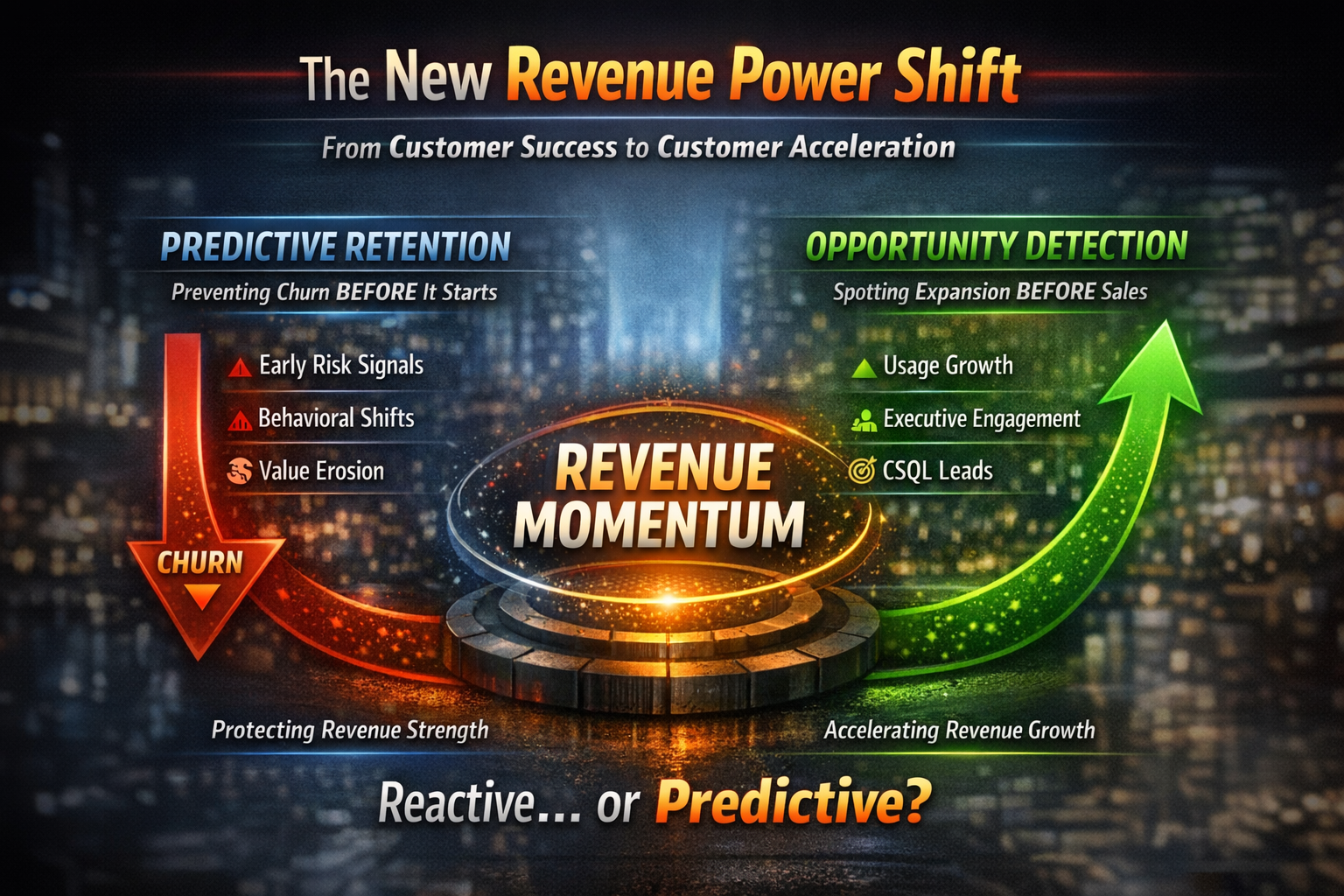
That’s why Predictive Retention matters.
Predictive Retention detects weakening momentum before churn risk surfaces.
It identifies behavioral shifts.
Engagement changes.
Subtle value erosion.
Not after the fact.
Before the revenue base becomes fragile.
If GRR is accountable revenue, you cannot manage it with hindsight.
You need foresight.
Growth Is Not an Event. It’s a Signal.
Now the other side.
Expansion rarely fails dramatically.
It stalls quietly.
Customers are “happy”… but not expanding.
Value exists… but isn’t documented.
New stakeholders are involved… but not activated.
Sales can’t see that early enough.
Customer Success can.
But only if opportunity spotting is systematic.
That’s where Opportunity Detection enters.
Opportunity Detection surfaces expansion readiness before the upsell conversation begins.
It detects:
Increasing usage depth.
Cross functional activation.
Executive level engagement.
Outcome validation moments.
It turns intuition into signal.
And when those signals are formalized, they become CSQLs.
Not guesswork.
Predictable pipeline contribution.
Predictive Retention + Opportunity Detection
This is the real shift.
Most companies manage churn separately from growth.
But revenue doesn’t behave in silos.
Revenue moves in two directions:
Downward through hidden fragility.
Upward through hidden momentum.
Predictive Retention protects the downside.
Opportunity Detection unlocks the upside.
Together, they reduce revenue fragility and increase revenue velocity.
That’s not a CS feature set.
That’s revenue infrastructure.
Why This Changes the Power Equation
If CS carries GRR.
If CS generates CSQLs.
If CS is responsible for early risk detection and early opportunity identification.
Then the center of gravity in recurring revenue companies moves deeper into the lifecycle.
Not politically.
Economically.
Because the real growth engine sits after the deal closes.
From Customer Success to Customer Acceleration
Customer Success asks:
“Will they renew?”
Customer Acceleration asks:
“Are they compounding?”
Compounding requires:
Stable GRR through Predictive Retention.
Systematic expansion through Opportunity Detection.
When both are engineered, growth becomes less fragile.
More predictable.
More measurable.
More scalable.
So maybe Sales won’t report to Customer Success in 2026.
But if GRR is accountable.
If CSQLs are signal driven.
If Predictive Retention and Opportunity Detection power the lifecycle…
Then the real question becomes:
Who truly owns revenue momentum?
And are you still reacting to dashboards…
Or engineering what happens before they turn red?
