


(A reflection on patterns we’ve observed in coaching & training organizations)
Over the past four years, in working with coaching and training businesses, we kept noticing the same thing:
Customer churn doesn’t arrive suddenly.
It whispers first.
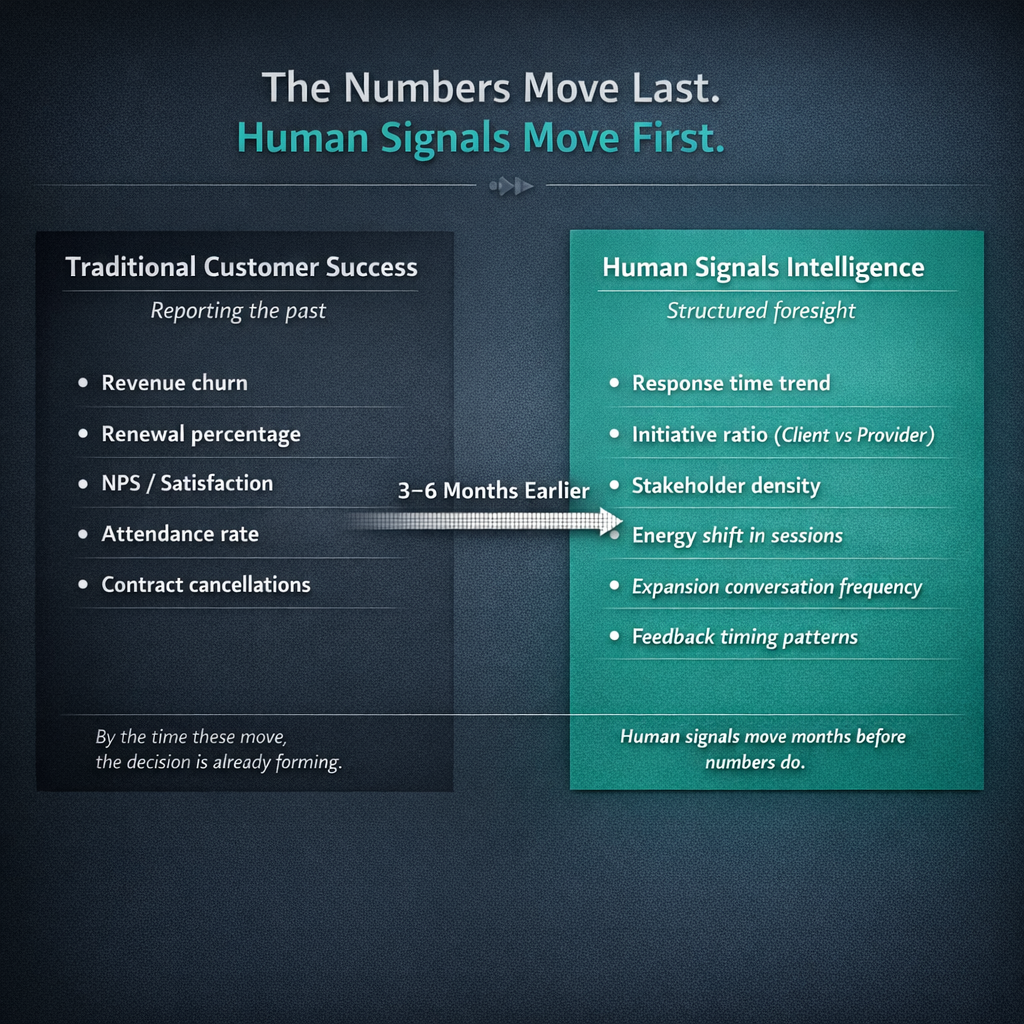
In roughly 80% of the organizations we studied, the earliest signs were visible 3–6 months before churn actually happened, long before traditional dashboards showed risk.
Yet most teams don’t catch these early signals.
Not because they’re hidden.
But because they’re human before they’re numerical.
Why Traditional Metrics Fall Short
Most retention dashboards react.
They show what happened.
By the time a churn metric moves, the internal decision to leave has often been forming for weeks, sometimes months.
In coaching and training businesses, relationships and perceived value are the product. When engagement shifts, revenue follows. Not the other way around.
If you want to predict churn early, you need to understand what changes before contracts end, before renewal conversations feel different, before invoices stop being paid.
That’s the difference between reporting and foresight.
What Early Signals Really Look Like
When we analyzed four years of churn cases, the patterns were consistent.
Churn in coaching and training environments rarely explodes.
It erodes.
Here are the signals that repeatedly appeared months before cancellation:
1) Engagement Starts Shifting
Gradually, not dramatically.
Fewer proactive check-ins.
Shorter conversations.
Delayed replies.
Trainers sensing “something feels off.”
2) Quiet Periods Increase
When weeks pass without meaningful interaction, engagement is already weakening.
3) Feedback Cycles Slow Down
Assignments or session outcomes get reviewed later than before.
Urgency declines.
4) Expansion Stops Naturally Emerging
Where additional programs or deeper engagements once developed organically, momentum slows.
5) Client-Led Initiative Drops
Participants stop suggesting improvements or next steps.
Internal sponsors become less proactive.
6) Stakeholder Involvement Declines
Decision-makers attend fewer sessions.
Champions become less visible.
7) Energy in Sessions Changes
Discussions become more transactional.
Language becomes cautious.
Commitment feels thinner.
Individually, none of these seem dramatic.
Together, they form a pattern.
And patterns precede churn.
The Real Insight: Churn Is a Human Journey
In coaching and training businesses, churn is rarely a sudden financial event.
It is the final step of a disengagement process.
Most organizations track:
- Revenue churn
- Renewal percentages
- Attendance
- Satisfaction scores
Very few track engagement decay.
But engagement decay is where churn begins.
The numbers move last.
Human signals move first.
From Intuition to Structured Foresight
Experienced coaches and training leaders often feel disengagement early.
But intuition alone is not a system.
When we began structuring leading engagement indicators into a simple monthly review rhythm, two things happened:
- Surprises decreased significantly.
- Conversations started earlier, while there was still room to strengthen the relationship.
Not because churn disappeared.
But because uncertainty reduced.
How HumintyX Cracked the Code
What ultimately made the difference was combining human experience with structured intelligence.
The HumintyX team brought together:
- 20 years of experience working with complex, unstructured data
- Proven human behavior models
- Algorithmic pattern recognition
- Modern LLMs
- AI agents capable of continuously detecting subtle engagement shifts
The breakthrough wasn’t in adding more dashboards.
It was in connecting behavioral nuance with computational pattern detection.
Unstructured human signals became structured foresight.
That’s where predictive retention became reliable, not theoretical.
A Practical Starting Point
If you want to test this approach, begin with five simple leading indicators:
- Trend in response time from key stakeholders.
- Ratio of participant-initiated vs. provider-initiated communication.
- Consistency of stakeholder attendance.
- Qualitative energy rating after major sessions.
- Frequency of forward-looking or expansion discussions.
You don’t need complexity to start.
You need pattern awareness.
Why This Matters
When churn stops surprising you:
- Forecasting becomes steadier.
- Planning becomes calmer.
- Internal discussions become more strategic.
- You gain time, and time allows intervention.
Retention isn’t about reacting faster.
It’s about noticing sooner.
A Final Reflection
When a client leaves your coaching or training program, was it truly sudden?
Or were there subtle signals, visible but unstructured, that preceded the decision?
In our experience, the signals are almost always there.
The question is whether you formalize them.
Warm regards,
Jeroen
